


Myopia
Management
Short-sightedness in children can be managed.
Is your child showing signs of short-sightedness or myopia?
Do they squint, blink excessively, or rub their eyes?
Do they complain of headaches?
Do they hold books and objects close to their face?
Do they sit closer to the television or at the front of the classroom to see?
Do they close one eye to read?
EVERYTHING YOU NEED TO KNOW ABOUT MYOPIA
Myopia, or short-sightedness, is a common vision condition where the shape of the eye makes the light entering it focus in front of the retina instead of directly on it. Or, in simple terms, it is when the eye grows too long, causing distant objects to appear unfocused and blurry, while close objects can be seen clearly.
Myopia is becoming more common. By 2050 it is expected to affect half of the world’s population (International Myopia Institute, 2021), and 30% of people in Southern Africa (Holden et al., 2016).
While it is a common refractive error in adults, the occurrence of myopia in children is becoming a growing concern worldwide. Although there may be many factors, it is thought that constant focusing on short distances by children – especially due to use of digital screens, reading, and other near work – while their eyes are still developing, plays a part.
Progressive myopia, or early onset myopia, is short-sightedness in children that worsens rapidly year after year because the eye continues to grow longer than it should at each age stage. If not managed, it can develop into high myopia, a severe form of short-sightedness.

Myopia raises the risk of some eye conditions later in life, and the higher the myopia, the higher the risk. Finding it early and managing it can slow its progress: slowing myopia progression by one dioptre during childhood should reduce the risk of developing myopic maculopathy (damage to the centre of the retina) by 40% (Bullimore and Brennan, 2019).
If your child is becoming short-sighted, there is a lot that can be done, and our optometrists will talk you through it.
Understanding the causes of myopia
Genetics
• Children of short-sighted parents are more likely to become short-sighted themselves, especially when both parents are.
Visual habits
• Increased near work such as intense activity with digital devices or books is likely to contribute to the growing prevalence of myopia in children.
Environment
• Evidence suggests that a lack of natural light and not enough time outdoors may contribute to myopia. Two hours outdoors a day is good for young eyes.
Binocular vision
• Pre-myopes show a higher accommodative lag with the correlation becoming stronger after onset of myopia, indicating this may be a feature and cause of myopia.
What can be done?
Once myopia develops, early diagnosis and management can slow its progress and help avoid high levels of myopia. The options include spectacle lenses designed for myopia management, specialised contact lenses and eye drops (low-dose atropine).
When you visit Torga Optical, one of our optometrists will do several vision tests with your child and check the health of their eyes. They will explain the results and every option, including treatments we don’t provide, and what each costs, before anything starts. You decide.

How Flexivue Myopia Management works
Spectacle lenses designed for myopia management are one of the ways of slowing myopia in children. Glasses are easy to get used to, well accepted by children, and nothing touches the eye.
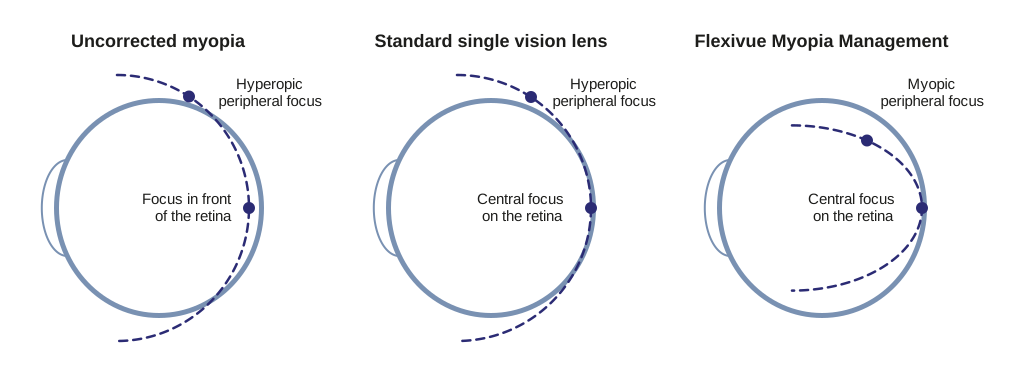
Flexivue Myopia Management uses IOT’s Perifocal design: clear in the centre, with extra focusing power towards the sides of the lens, an approach being studied for slowing myopia in children. It has not yet been tested in a randomised controlled trial, so your optometrist will explain the evidence and the alternatives.
The design is on the back surface of the lens, so the glasses look like ordinary glasses, with no visible rings.
The centre of the lens fully corrects your child’s prescription. Towards the sides, it focuses light slightly in front of the retina rather than behind it, as the diagram shows.


Useful tips for parents
Getting used to them: usually one to two weeks. Your child sees clearly through the centre of the lens; the sides are slightly blurred on purpose.
Until they’ve got used to them: no cycling, scooters or active sport.
Wearing them: all day, every day, except for sleeping and active or rough sport.
Fit: check every day that the glasses sit straight and in the right place, and bring them in to be adjusted whenever they don’t. Adjustments are free for the life of the glasses.
Check-ups: every six months, to measure how your child’s eyes are changing and adjust the treatment, until their myopia has been stable for two years.
At home: at least two hours outdoors every day, regular breaks from reading and screens, good light, and a sensible working distance.