












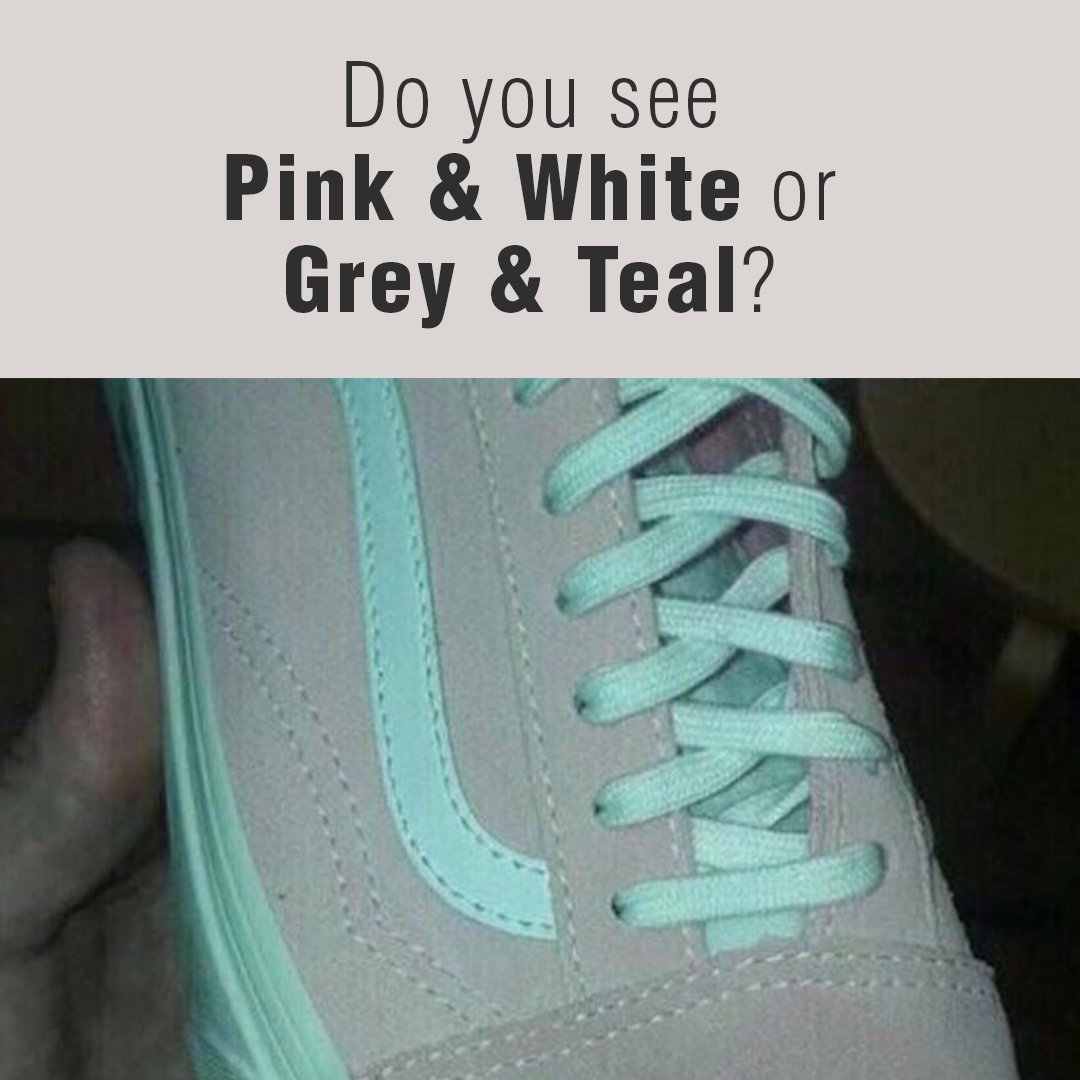
Do you see pink and white, or grey and teal? A photo of a trainer went round social media in 2018 and split families and offices into two camps. The answer lies in how your eyes and brain work out colour.
What is colour?
To see colour you need three things: an object, light and an observer. White light contains all the colours of the visible spectrum. When it hits an object, some of those colours are absorbed and the rest are reflected. The reflected colours reach the retina at the back of your eye, where the cone cells send signals to the brain, which turns them into the colour you see.
Light changes colour, and your brain corrects for it
The colour of the light changes the colour of everything you see. Daylight changes through the day. An ordinary incandescent bulb gives a yellowish light that brings out warmer colours, while a fluorescent tube is bluer and gives objects a cooler feel. Your brain adjusts for the light it thinks it is looking at, so that a white shirt still looks white indoors and out.
So why two answers?
The trainer in the photo was shot in low light, so the brain has to guess what light it is seeing the trainer in. If your brain decides the light has a bluish cast and discounts it, you see pink and white. If it decides the light is warm and discounts that, you see grey and teal. It is the same photo and a different guess. This is what is called a colour illusion: the colours around an object trick the brain into misjudging the true colour of the object.
In real life, the trainer is pink and white.
Your eyes at an eye test
An eye test checks far more than a chart of letters: how well you see, how your eyes work together, your colour vision and your side vision, and the health of your eyes. Book an eye test.